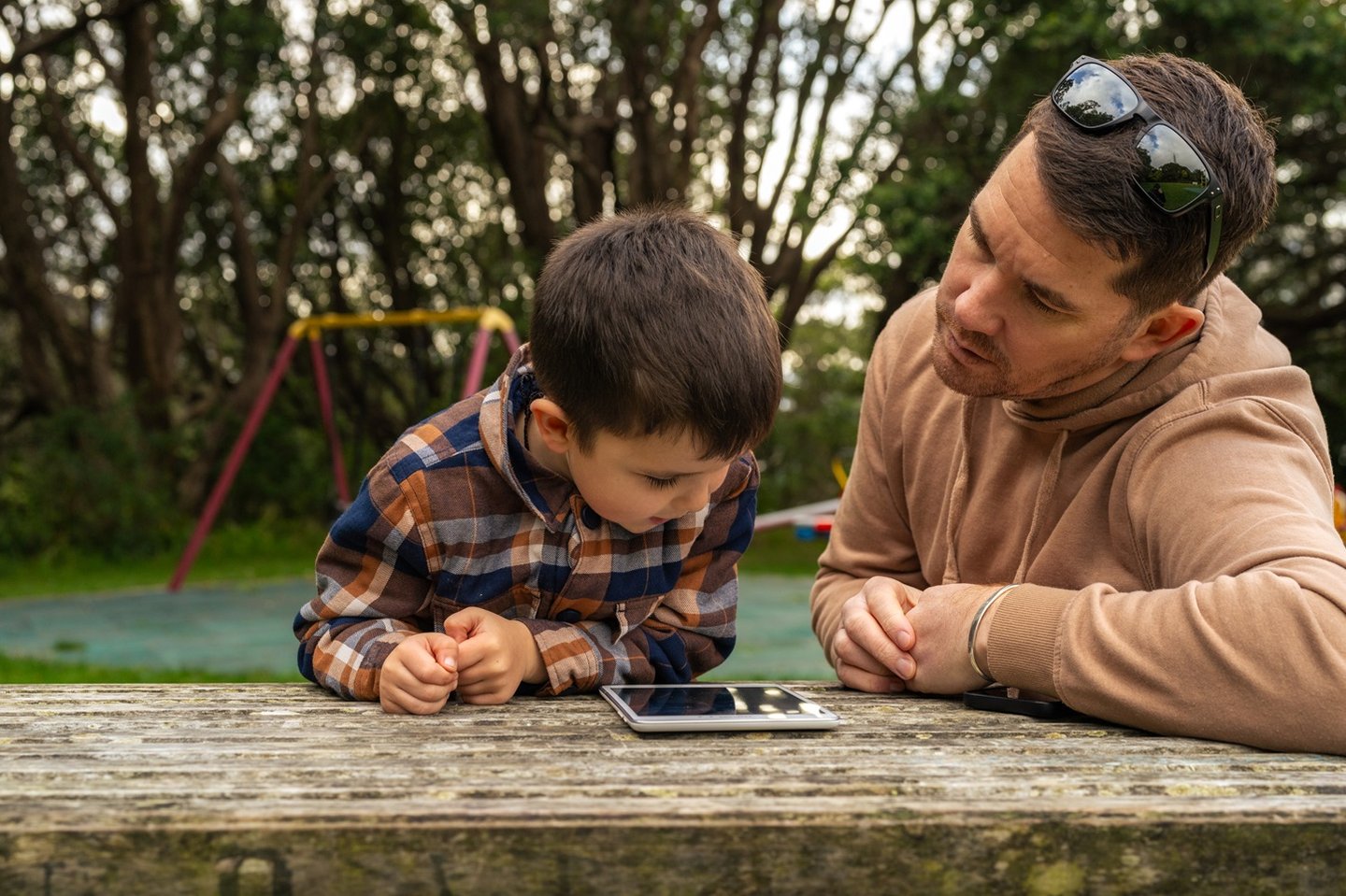
Talking with your tamariki about content that doesn’t feel right

Caitlin on March 19, 2026
Since my child was little, we’ve talked about something simple: sometimes when you’re reading a book, watching TV, or using the internet, you might see something that makes you feel scared, confused, or uncomfortable.
If something is scary, younger children might tell you straight away. Sometimes it comes up later, often at bedtime, when their brain starts replaying the day.
If something is confusing, the reaction can look different. It might come out hours later as a completely random question that seems to appear from nowhere. Or they might try and process it on their own then come up with some interesting theories that aren’t quite right.
When that happens, the important thing is to talk about it, and encourage them not to internalise it. The message I’ve always tried to reinforce is that we can work through it together. I might not always have all the answers, but I do know a bit about what’s out there.
Recently, this approach paid off in a way I didn’t quite expect.
The vampire book
At school my daughter had been learning about myths. Her teacher explained that sometimes myths are stories where we don’t always know what is true. She also talked about the difference between fiction and non-fiction and that fiction stories are made up, while non-fiction books contain factual information. Which is right, but had consequences with what happened next.
Later, one of the students pulled a book about vampires from the non-fiction section of the library, and a group gathered around to look through it.
For my daughter, this was confusing. If the book was in the non-fiction section, that meant it must be real.
The pictures were very frightening. But like many children with curiosity, she found it hard to look away.
When she got home she briefly mentioned something about vampires, but nothing seemed too unusual. I didn’t think too much of it at the time.
It wasn’t until later that night, just before bed, that the real impact surfaced.
She suddenly became very upset and told me she needed to cover her neck because she was worried about vampires. She explained about the book she had seen and the pictures inside it.
A first encounter with scary content
In that moment I realised something important had happened.
For the first time, my child had come across something in a book that genuinely frightened her.
Just as importantly, she had done exactly what we had talked about. She told me about it. Here’s how I handled what came next:
- Acknowledging how she felt. I told her that what she described sounded really scary, and that it made sense she felt worried after seeing something like that.
- Then, we started unpacking the content together.
- We talked about vampires and where those stories come from — old legends and folklore from parts of Eastern Europe, sometimes connected to historical figures who weren’t particularly kind.
- We reached the key point: the vampires described in those stories aren’t real, even though they appear in lots of books, films, and TV shows.
That part came last.
She was still a little nervous that night, but she was able to go to sleep. By the following evening she didn’t mention it again.
For a child who can sometimes fixate on scary ideas at bedtime, that was a big step.
Why moments like this matter
Experiences like this can become powerful early media literacy lessons.
Children learn that sometimes the things they see in books, online, or on screens can feel confusing or upsetting. What matters most is knowing what to do when that happens.
Open, calm conversations help children understand that the response isn’t:
- getting in trouble
- having devices taken away
- or being told off for being curious
Instead, the response is talking about it together.
That foundation becomes even more important as children grow older.
At some point many young people will come across content they weren’t expecting, whether that’s something that appears online, a video shared on social media, something in a group chat, or content shown to them on someone else’s device.
When children already know they can talk about what they’ve seen without being blamed or punished, they are far more likely to come to a trusted adult when something doesn’t feel right.
Building trust early
These early conversations are also practice.
Children learn that if they see something upsetting, they can pause, step away, and talk to someone they trust.
But staying calm matters.
Children can easily mistake our fear or worry for anger. Keeping the conversation steady helps them understand that they’re not in trouble.
Over time, this builds something much more important than a single solution to a scary moment.
It builds trust.
And that trust is what makes it far more likely that when children eventually encounter something more serious online, they’ll know exactly what to do next - close the device, step away, and come talk to you.
Further reading:
The 'Bluey' parenting hack - Blog
Brain development – how it works, why it matters - Resource
You're in control with parental controls - Resource
Subscribe to our blog
Stay up to date with the Classification Office blog.