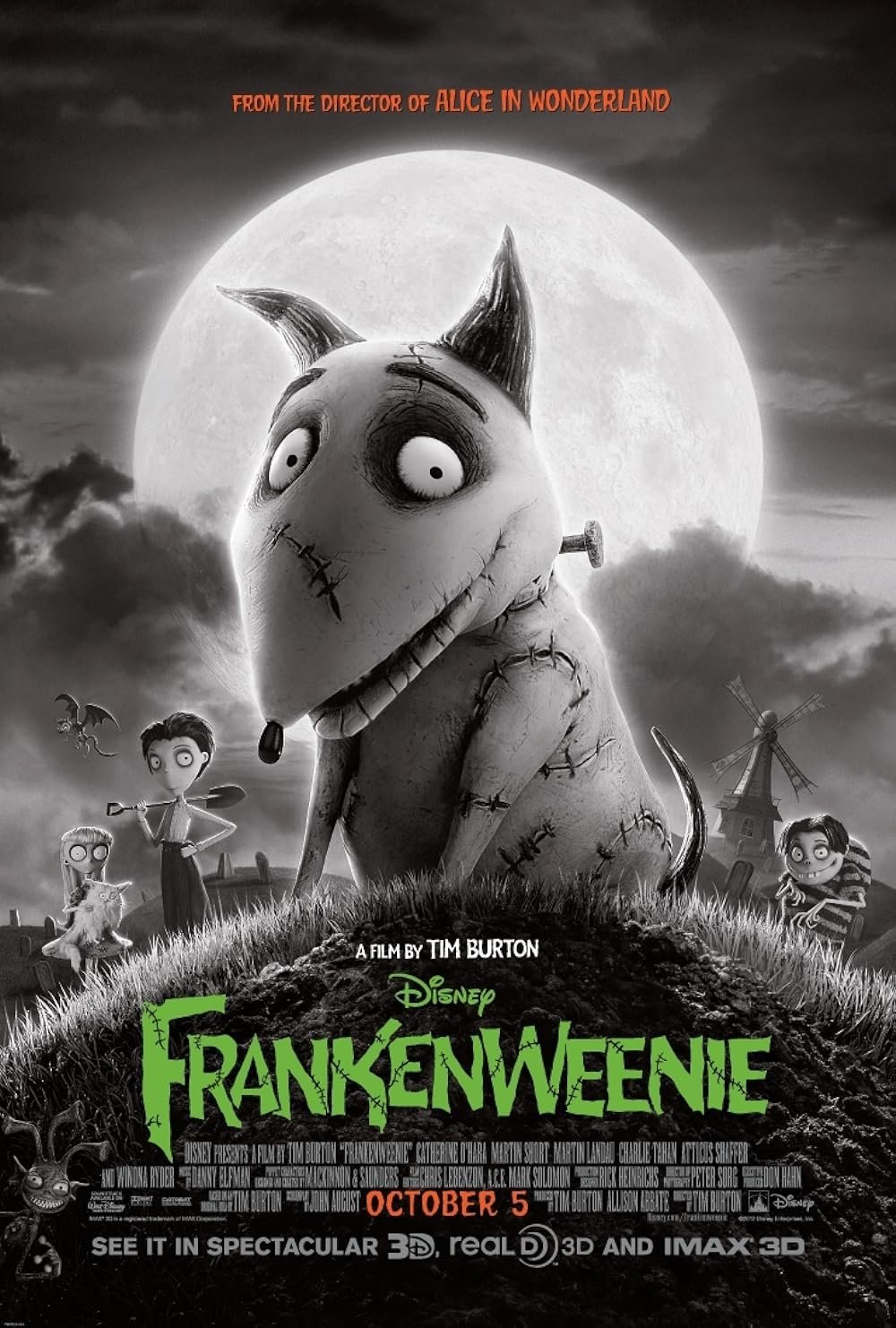
Frankenweenie
NZ release: 18 October 2012
Scary scenes Rated on: 18 October 2018
What’s it about?
When a boy’s beloved dog passes away suddenly, he does the unimaginable and pushes the boundaries between life and death through the power of electricity.
The facts
- Directed by Tim Burton (Alice in Wonderland, Corpse Bride)
- English language with some Japanese dialogue
- Runtime: 87 minutes
- Inspired by the Frankenstein tale
Why did it get this rating?
This film was cross-rated by the Film and Video Labelling Body. You can find out more about cross-rating here.
Horror
The visual style and character designs are like in Tim Burton’s other stop-motion films like Corpse Bride and The Nightmare Before Christmas.
There are dark, gloomy, and abnormal characters. For example, one character has abnormally large eyes and another one has a large hunchback.
Various dead pets are resurrected and mutate into horrifying creatures. They are visually terrifying as they have features such as sharp claws, teeth, and wings.
Violence
A mutated creature fights with Sparky. The fight turns violent, and they bite and claw each other. The fight ends when a burning wooden beam falls and impales the mutated creature. We briefly see their dead body.
Various animals are resurrected and mutate into horrifying creatures. They terrorise the townsfolk by chasing them and wreaking havoc.
A character jumps off the roof for a science experiment. We see them jump off and break their arm.
Sparky is hit by a car. We don’t see this, but do see the car stop after Sparky yelps.
Further information
Recent featured decisions

Pursuit of Jade
Pursuit of Jade, Season 1
Violence and suicide
A young woman marries a disgraced nobleman to survive. They grow to love each other – but their love is challenged at every turn by political schemes and insidious secrets. They must fight, even go to war, to stay together.